
3 min read
Updated October 6, 2025
Study Summary#
Research use only. NeuroNexus products and the procedures described here are for non-clinical research use, and must not be used in human or veterinary medical procedures.
The requirement was dense EEG coverage in rats without a craniotomy, laid out to match the constructs used in human high-density EEG.
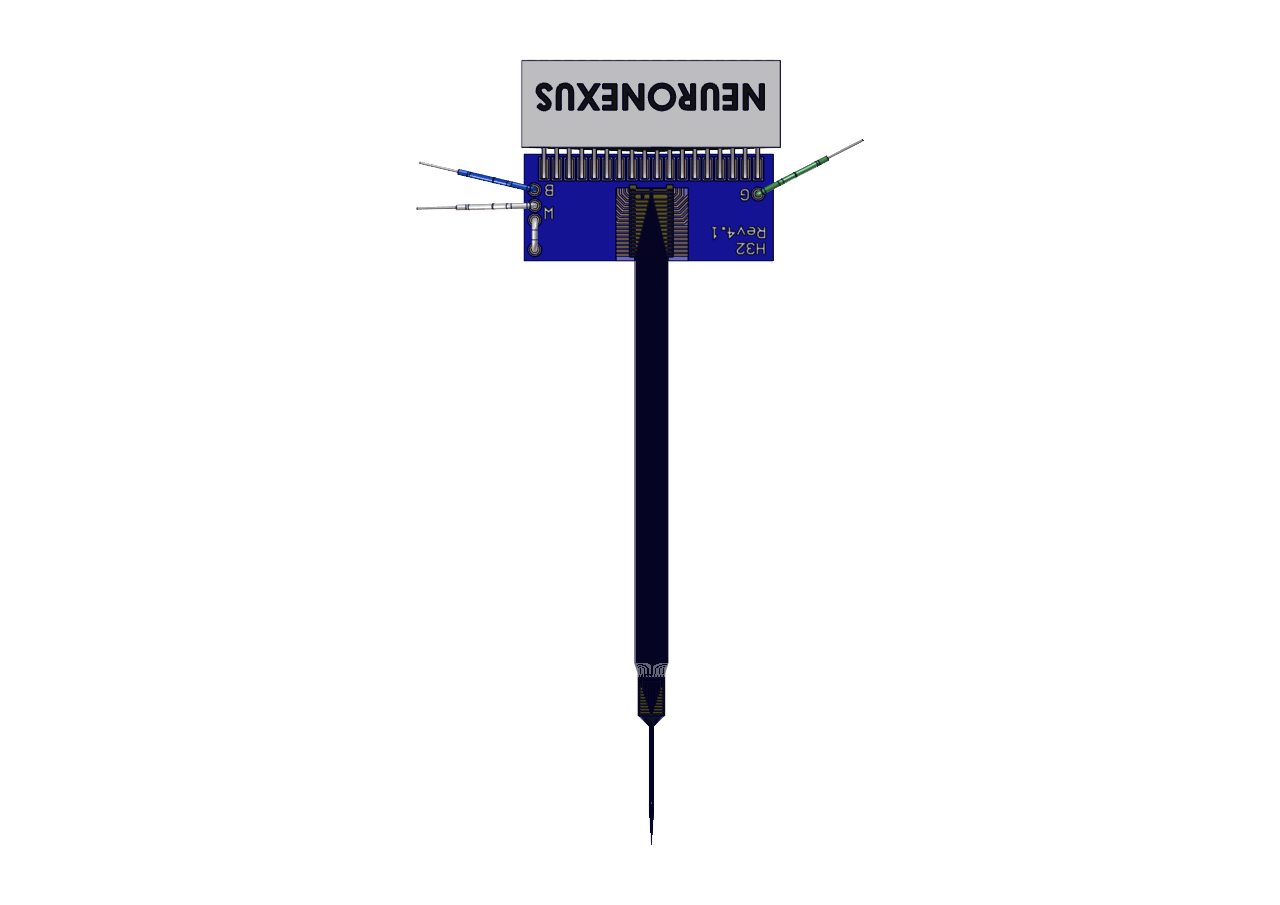
The array is a 12 µm polyimide thin-film grid with an integrated polyimide ribbon cable, made on the NeuroNexus polymer microfabrication process. Fourteen sites record EEG. Two more connect to bilateral EMG electrodes, so staging comes from the same implant as the EEG. The grid terminates in an H32 package with an Omnetics connector.
Sessions ran six hours at 1 kHz inside a 1 × 1 m Faraday cage. Acquisition used an Open Ephys system with a 32-channel headstage and an integrated accelerometer. A crosshair fiducial on the grid aligns to bregma, which is what makes placement comparable between subjects.
Adult rats were followed for up to one month, with no bone removed at any point.
What We Delivered#
One implant carrying three measurements: fourteen EEG channels on the skull surface, two bilateral EMG leads, and head-mounted accelerometry from the headstage. Sleep and wake staging comes from the EMG and accelerometer, and the EEG is scored against it. State and spectrum are measured on the same clock.

Outcomes#
The grid resolved state-specific spectral and connectivity differences in vivo.
Sleep-wake distributions shifted in SYNGAP1 heterozygotes. Band-limited power differences localized over frontal and parietal channels, by state. Magnitude-squared coherence fell in defined bands and the effect persisted across sessions.
The measurements map onto constructs used in human HD-EEG analysis, and skull-surface placement preserves the volume-conduction pathways that make that comparison meaningful. Bregma alignment, inbound QC and fixed acquisition parameters are what held the effects stable across subjects.
What other labs can reuse#
The array is available, and the bregma-aligned placement procedure is described in the investigators' published papers. That makes cross-site replication practical.
Two parts transfer: the fixed six-hour session structure, and taking staging from EMG and accelerometry rather than from the EEG being analysed. Both carry over to any power or coherence workflow.
Running it on NeuroNexus acquisition. The same preparation runs on the XDAQ recording systems with Radiens for acquisition and analysis. Talk to an application scientist about matching the package to your existing rig.
Resources#
Publications
Katsanevaki et al., 2024, Cell Reports 43, 114733 ↗